

The circle of it: creating biomaterials to replace the use of animal leather using bacterial cellulose grown on waste coconut water from the coconut processing industry.
MALAI ECO
Summary
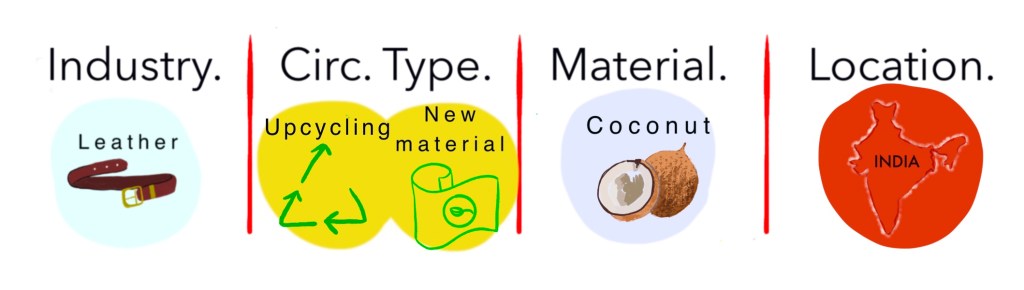
Malai Eco is a sustainable materials startup based in Kerala, India, that produces a vegan, home- compostable alternative to leather using waste coconut water and natural fibers. (Source) The company works with South India’s coconut farmers and processing units who find themselves with an excess of “waste” coconut water after removing the harvest of white flesh from inside the mature coconuts. This water could have been released into the drainage system, but unfortunately causes pollution of water and the soil to become acidic. By some estimates, even a small coconut processing unity disposes of up to 4000 litres of “waste” coconut water per day. (Source) The company rescues this coconut water to create a natural nutrient upon which to feed their bacterial culture. The resulting sheet is enriched with natural fibres (banana stem, hemp, etc.), gums and resins to create a more durable and flexible material which may then be formed into flat sheets in a range of thicknesses and textures, or moulded seamlessly into 3D structures. The resulting material is plastic-free, water-resistant, and fully home-compostable, offering a leather- or paper-like texture suitable for fashion, accessories, packaging, and interiors. The company uses all natural plant dyes to dye the “leather” using a patented dying method. Due to its natural composition, it is sensitive to humidity, much like paper or leather, and often requires a thin layer of beeswax or coconut oil to be applied on the surface. The material can last up to 8 years. (Source)
Story
Malai Eco’s founders Susmith C.S., a product designer and mechanical engineer from Kerala and Zuzana Gombosova, a Slovakian material researcher, met by chance in Mumbai in 2015. Gombosova had spent years exploring microbial materials, and Susmith—hailing from “the land of coconuts”—recognized an opportunity in Kerala’s abundant coconut-water waste. In 2016–2017, they left their corporate roles, relocated to Southern India, and began intensive experimentation before landing upon their first successful material which would become Malai Eco. (Source)
” We tend to look at animal leather as this solution for everything because it’s so durable. Yes, if you use it and it’s good leather, it will last you easily for decades. You can rely on this material, but there’s a certain cost. And perhaps it shouldn’t be like that. We just want this solution for everything and we ended up choosing either leather or PU leather. But there are lots of applications where you don’t need the durability of 20 – 30 years.”
Zuzana Gombosova in an interview
Founder(s)
Susmith C.S. and Zuzana Gombosova
Headquarters
Kerala, India
In business since
2016
Technology
Creating a leather alternative by upcycling waste coconut water and combining it with natural fibers and resins
Impact

Leave a comment